
Following The Butcher
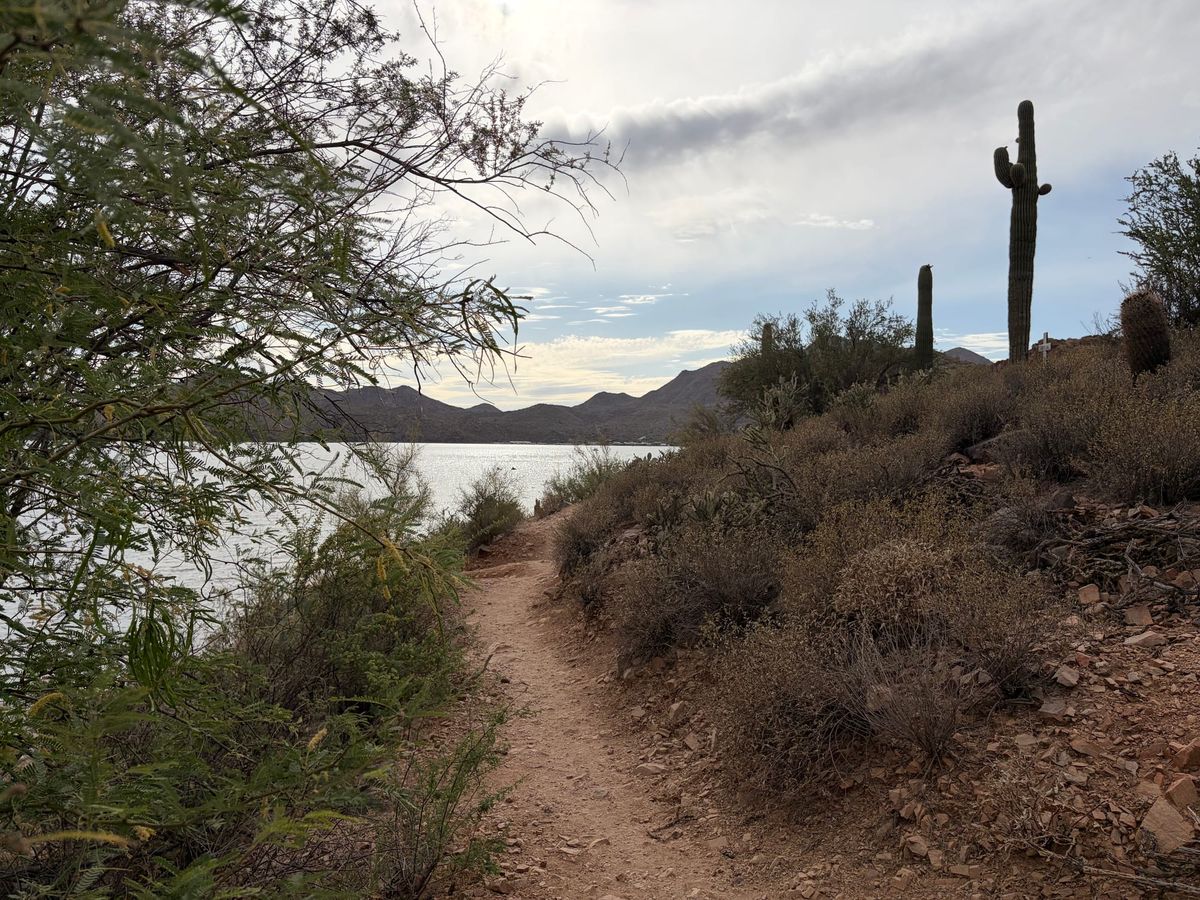
I had never been to Saguaro Lake before we got a boat in 2023. I didn’t even know much about the area, but it was the first lake we took the boat to, and it quickly became our favorite.
Canyon walls rise from the water, shifting in color as sunlight and shadows move across them. Brisk spring mornings, when the sun starts to rise earlier while we come out of winter hibernation, are my favorite times to be out on the lake. It’s chilly enough that I can wear oversized sweats and wrap myself in a big comforter while the wind tangles my hair and crisp morning light bouncing off the neon water dances like glitter. It is ridiculously cozy.
On this particular day, the water was unusually choppy and the sky an ominous gray, the clouds full of drama, threatening to drop an angry storm from the sky. I had lived through plenty of Arizona storms, but this would be my first on a little boat in the middle of an unforgiving canyon lake, deep in the rocky terrain of the Tonto National Forest.
The wind whipped angrily, the sky gave way, and the rain dumped.
All we had for shelter was the canvas shade over the top of the boat, only slightly less flimsy than a standard rain umbrella. The waves were whitecapping, and the boat rocked violently from side to side. We made our way toward a small cove on the north shore, near a little beach we had passed countless times from a distance.
Normally, dozens of colorful beach umbrellas line the pebbly shoreline of this little nook tucked into the jagged desert, filled with kids’ laughter and families relaxing. Today, towels and beach toys were blowing away as people ran for shelter.
In that moment I thought, Butcher Jones... that’s an strange name for a beach.
And just like that, the rain halted, the wind calmed, and the sky cleared to a pristine blue.
We dried ourselves off and continued on our normal journey through the lake. When it was time to head home, we passed the beach again and it had returned to its picturesque self: bright umbrellas, kids swimming, kayakers, laughter and barbecue.
I thought of the name again.
Butcher Jones Beach. That’s a really odd, unsettling name for a beach.
In an instant, my mind was somewhere else entirely. Summer campers. An isolated shore. A killer known only as “The Butcher.” Maybe by day he was the camp cook and by night something considerably more sinister.
Why is it called “Butcher” Jones?
When we got home, I started digging.
At the time, there wasn’t much to find. One of the only useful things I came across was an Arizona Republic/AZCentral piece in which the same basic question was being asked: Why is it called Butcher Jones?
The answer wasn’t certain, but the name was most likely connected to an early Arizona pioneer, Dr. W.W. Jones, who reportedly performed surgeries on his kitchen table under frontier conditions, possibly earning him the nickname “Butcher.”
My vision of a summer-camp horror story was more real than I thought. I needed to know more.
I found W.W. Jones on Find A Grave. Now I knew where he was buried. I began finding bits and pieces of a surprisingly storied life: California, ranching, a sanitarium, the Vulture Mine and connections to people and stories already woven into Arizona lore.
This man wasn’t just the answer to a weird beach name anymore. He was becoming a person, yet his history was vague, which I found particularly odd considering how intertwined he had been with early Arizona. I visited his grave and the home he built in Phoenix. Somewhere along the way, something even more interesting began happening: the story didn’t quite add up.
Some historical records identified him as Wilson Walker Jones. Others called him Walker Wilson Jones. Standing at his grave, I found Walker Wilson Jones carved into his stone. Historical records identified his wife as Alcaria Montoya, yet her grave read Arcadia.
The further I followed Jones, the more I realized how messy records and history can be. Names change, details disappear and stories get twisted. One person’s account becomes another person’s source. Eventually, the version that survives can depend as much on who recorded it as on the person who actually lived it.
The rabbit hole widened beyond W.W. Jones. I had always loved Arizona ghost towns and old mining history, and I am mesmerized by the Superstition Mountains. But now I was looking at this place differently. The Lost Dutchman. Gold and copper mines. Ghostly names on maps. Legends and lore. So much had been hiding in plain sight all around me.
In the middle of all this, there was surfing, the part that makes almost as little sense as everything else.
Arizona has a surprisingly strange relationship with surf culture. Big Surf opened in Tempe in 1969 and became North America’s first inland surfing facility, generating rideable waves in the middle of the desert. Around the same time I was dreaming up Butcher Jones, Revel Surf at Cannon Beach was under construction, preparing to bring surfing back to the Arizona desert.
So when my imaginary horror-movie camp took shape on the shore of Butcher Jones Beach, of course it became a surf camp. A mysterious frontier doctor becoming the face of a surf company made no sense, in exactly the way my maximalist mind loves weaving obscure ideas together.
As hot ideas often do, Butcher Jones Surf Co. burned bright in my mind. But family priorities took precedence, and The Butcher went quiet for more than a year.
When we took the boat back out in the spring of 2026, it all came rushing back, burning hotter than ever. Then I noticed something I had missed.
W.W. Jones was born in 1826.
It was 2026.
Two hundred years.
I started feeling as though Jones had waited two hundred years for someone to come looking for him. I felt called to tell his story.
Today, I have notebooks full of ideas, photographs, research, stories, characters and places I want to investigate. There are Butcher Jones Surf Co. stickers that have traveled farther around the world than I have. That strange little question, Why is it called Butcher Jones Beach? has even changed how I think about my own legacy and the kind of work I want to spend my life making.
The Butcher has sent me on a scavenger hunt across Arizona, uncovering stories odder than fiction could write.
And I’m still following him.
This is where I’m going to record what I find.